
Your RP Thread Is Long. Your Story Isn't.
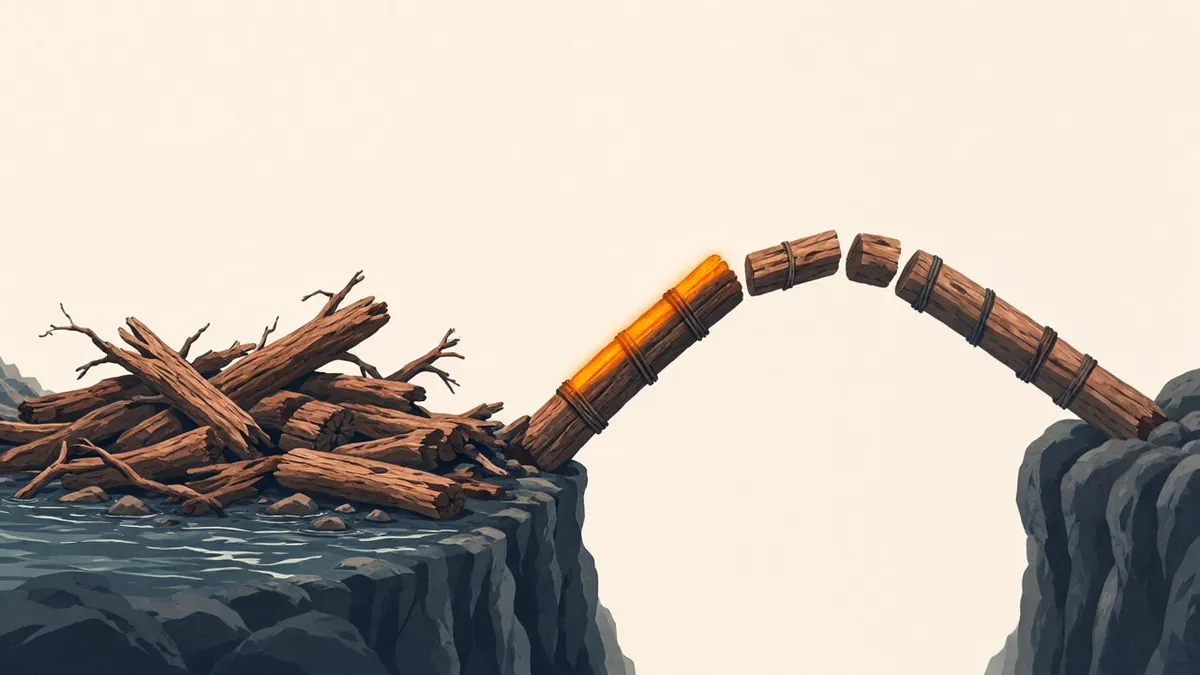
Short answer
RP logs have scenes and dialogue. You need structure: cut, reorder, bridge with cause and consequence until it reads as narrative, not transcript.
Why RP Logs Don't Read Like Stories
You've got 200 pages of thread. Maybe more. The dialogue is sharp, the tension between your characters crackles, and three of those scenes make you laugh out loud every time you scroll back to them. But you open the document to start shaping it into something a reader can follow, and it collapses. Everyone talks. Everyone reacts. Nothing happens because of anything else. A scene ends because someone logged off, not because a decision was made.
RP logs are turn-based by design. You act, your partner reacts, you react, they act. That loop is fun to play in and exhausting to read in sequence. The gap between "fun thread" and "readable story" isn't talent or imagination. It's three structural jobs you can do mechanically, and none of them require you to rewrite the good lines.
Three Things Your RP Thread Is Missing
Cause and consequence. In RP, events happen because someone typed an action. In a story, events happen because a prior event made them inevitable or at least logical. The fix is mechanical: for every scene, ask "what earlier scene made this one necessary?" If the answer is "nothing, I just wanted to see my character in a bar," that scene gets cut or merged. You're not losing content. You're losing a detour.
One point of view per scene. RP gives you access to everyone's head simultaneously, because both writers are narrating. A novel picks one pair of eyes per scene and stays there. Everything the other character does, you see from the outside. This isn't a style preference. It's what creates tension: the reader doesn't know what your love interest is thinking, so every smile becomes ambiguous. If you're still deciding between tight first person and close third, this breakdown of first vs. third person walks through what each choice costs you in a romance-heavy draft.
Scene transitions with narrative glue. In RP, scenes are separated by a line break and someone typing "three hours later." In a story, you bridge. A paragraph of the character walking to the next location, thinking about what just happened, deciding what to do next. That bridge is where internal narration lives, and it's where you earn reader trust. Without it, scenes feel like a slideshow.
The Cut-and-Keep Pass
Do this before you add a single new sentence. It takes one pass with a highlighted document and twenty minutes.
| Mark this | Color | Why |
|---|---|---|
| Gold dialogue that captures a character's voice | Yellow | Keep verbatim. This is your material. |
| Scenes where a character learns something new or makes a choice | Green | These are your plot beats. Everything else orbits them. |
| Repetitive "I look at you, you look at me, I smile" exchanges | Red | Cut. Summarize in one sentence if the emotional beat matters. |
| OOC breaks, logistics chatter, "wait what does your character look like" | Gray | Delete. These are not content. |
| Scenes with no cause, no consequence, no new information | Orange | Cut or merge into the next green scene. |
After this pass, you should have 40-60% of your original word count. That's correct. The story was always shorter than the thread. You're just revealing its actual length.
Restructuring Without Killing the Voice
The thing that makes your RP logs worth adapting is the dialogue voice. Your characters talk in specific, recognizable ways, and that's harder to fake in straight prose than it is to maintain from a thread. Protect it.
Work in this order:
Lay out your green scenes in order of cause. Write one sentence per scene: "Because X happened, Y now does Z." If you can't write that sentence, the scene doesn't belong in this order or doesn't belong at all.
Choose your POV character per scene. Mark it. Now go through the scene and delete any line that tells you what the other character is feeling, unless your POV character could observe it. "He felt guilty" becomes "He wouldn't meet her eyes and kept picking at the table edge." You already wrote that detail in the thread. You just need to cut the head-hop line above it.
Add the bridges. 2-4 sentences between scenes where the POV character moves, thinks, decides. You don't need to write a novel in those bridges. You need a reason to leave one scene and arrive in the next.
Example bridge: The bar went quiet in the way bars go quiet when you realize the person across from you is actually telling the truth. Mara set her glass down, left the beer untouched, and walked out into rain that hadn't been there when she sat down. She needed to find the apartment before she changed her mind. Three blocks. She counted them in her head because counting was something she could control.
Flat version: She walked to her apartment and thought about what had happened.That sentence names a location and a verb of thinking. The Mara bridge gives you weather, a physical tell (leaving the beer untouched), an internal deadline, and a small nervous ritual. If your bridge could be swapped into any scene in the book without anyone noticing, it isn't a bridge yet.
Getting the Logs Into a Working Document
If your thread is split across a forum, a Discord, a Google Doc, and three screenshots from a group chat, the first obstacle is not craft. It's getting all the text in one place in a format you can actually edit.
If your logs are scattered and you just need to pull them into one editable file before you start the structural work, you can import your existing manuscript or logs as a starting draft and edit on top of them, rather than copying-and-pasting 200 pages into a blank doc and losing all your formatting.
With everything in one file, the passes above become searchable rather than scrollable, which is the practical difference that makes them survivable.
Maintaining Continuity Across a Long Thread
RP logs written over months accumulate continuity problems that aren't obvious scene-by-scene. A character references a wound that was never described. A location changes color between chapter 4 and chapter 19. A side character who was dead in one scene shows up at a party three chapters later, because both you and your partner forgot the conversation from week three.
This is where a story bible stops being optional. You don't need an elaborate one. A running list of: who knows what, who's alive, what they're wearing, where they are, what's been said out loud that other characters couldn't have overheard. When you're 80 pages into a rewrite and a scene contradicts something from page 12, the bible catches it in ten seconds instead of ten minutes of scrolling.
For the dialogue-rewrite pass itself, where you're going line-by-line to tighten, cut head-hops, and add narration, a co-writing tool that lets you work through a document section by section while keeping your voice rules visible makes that grind less brutal. You paste a scene, apply your POV and tense rules, get a tightened version, and you still make the final call on every sentence. The tool does the repetition. You do the taste.
The Voice Check Before You Call It Done
Read your first three chapters out loud. Not to someone else. To yourself, at your desk, talking to the wall. Where you stumble, where your internal voice drifts flat, where you start skimming instead of reading. Those are the places where you left a bridge too short, kept a "and then" transition, or held onto a green scene that doesn't actually earn its spot.
You don't need a beta reader for this pass. You need your own ears and five minutes of honesty. The scenes that make you speed up to get past them are the ones that need another cut or a rewrite. The scenes where you lean in and forget you're reading your own work are the ones you keep exactly as they are.
The story was always in the thread. You just had to stop treating every line as load-bearing.
Frequently asked questions
Can I adapt RP with someone else without crediting them?
It depends on your original agreement and the platform you posted on. If your RP was a private collaborative project, talk to your partner before publishing an adapted version. If it was public and you want to change names and specifics enough to call it original, you're on your own legally, but a courtesy heads-up costs you nothing and preserves the friendship.
How do I handle scenes where both characters were equally compelling?
Pick the one whose story you're actually telling and keep the other as a strong supporting presence. If you truly need both perspectives, alternate POV by chapter rather than by scene, so the reader gets whole scenes instead of ping-ponging every three paragraphs. This is more work than a single POV but it's doable in a romance where both characters carry the emotional arc.
My RP has explicit scenes that carried most of the tension. How do I adapt those without the thread pacing that made them work?
In RP, a slow-burn scene worked partly because of real-time anticipation and partner response. In prose, you earn that tension with interiority and withheld detail. Cut most of the physical play-by-play. Keep the emotional turning point, the one thought or realization your POV character has mid-scene, and frame the rest through that. The scene structure guide for [kissing and intimate scenes](/blog/how-to-write-kissing-scenes) walks through what to expand versus compress.
Should I adapt the RP as-is or change names, settings, and details?
If you're publishing as original fiction, you'll need to change enough to avoid recognizable fanfic overlap: names, settings, specific lore. If you're posting it as a fanfic "adaptation" thread, keep the names and post it as its own fic with a note in the author's notes. Either way, the structural work above is the same. The renaming pass is the last thing you do, not the first.
Want Paige to try these techniques on your story?
Start writing freeRelated reading
Should I Use a Pen Name for My Romance Novels?
Pen name vs. real name for romance authors: the privacy tradeoff, brand math, and a quick decision framework for indie publishing.
Can You Copyright a Book Written With AI?
US Copyright Office guidance says human authorship drives protection. Here's what counts as yours when you co-wrote a book with an AI.
Is Fanfiction Legal or Just Not Getting Sued Yet
Fanfiction lives in a copyright gray zone. Here's what non-commercial posting, commercial use, and platform policies actually mean for your stories.
How to Write a Synopsis Without Losing the Story
An agent synopsis and a back-cover blurb serve opposite jobs. Here's how to write one that shows structure without flattening what makes your story work.