
How to Write Grief Without Wallowing
Short answer
Underwrite it. Put grief in small specific actions and dialogue that dodges the subject, so readers supply the emotion instead of the prose performing it.
You finish the funeral chapter, reread it, and everyone in it is sobbing. The narration calls the pain unbearable twice. The dog howls. And none of it moves you, because the scene keeps announcing an emotion it never earns. If your grief scenes read as melodrama, the problem is almost never that you feel too little. It is that the page does all the feeling for you.
The Short Answer
Underwrite grief. Anchor it in small, specific actions and in dialogue that avoids the actual subject, so the reader generates the sorrow themselves instead of being told about it. Wallowing happens when the prose insists on the emotion; the ache happens when the prose barely admits it exists.
That sounds vague until you see the specific moves. Here they are.
Why Grief Scenes Tip Into Melodrama
Melodrama is what happens when the writer names the feeling, stacks adjectives on top of it, and stages weeping, screaming, and rain, all at maximum volume from the first line. Nothing is left for the reader to contribute, and big emotions lose power fast when they arrive pre-interpreted.
There is a structural reason this traps writers. Grief is enormous and abstract, so the instinct is to match the size with big gestures and big vocabulary. But abstraction flattens a scene. The antidote is always scale reduction: shrink the event to its smallest visible unit and trust the reader to expand it again. This is the same muscle behind strong exterior detail in general, and you can practice it with concrete show-don't-tell swaps.
Write the Absence, Not the Sorrow
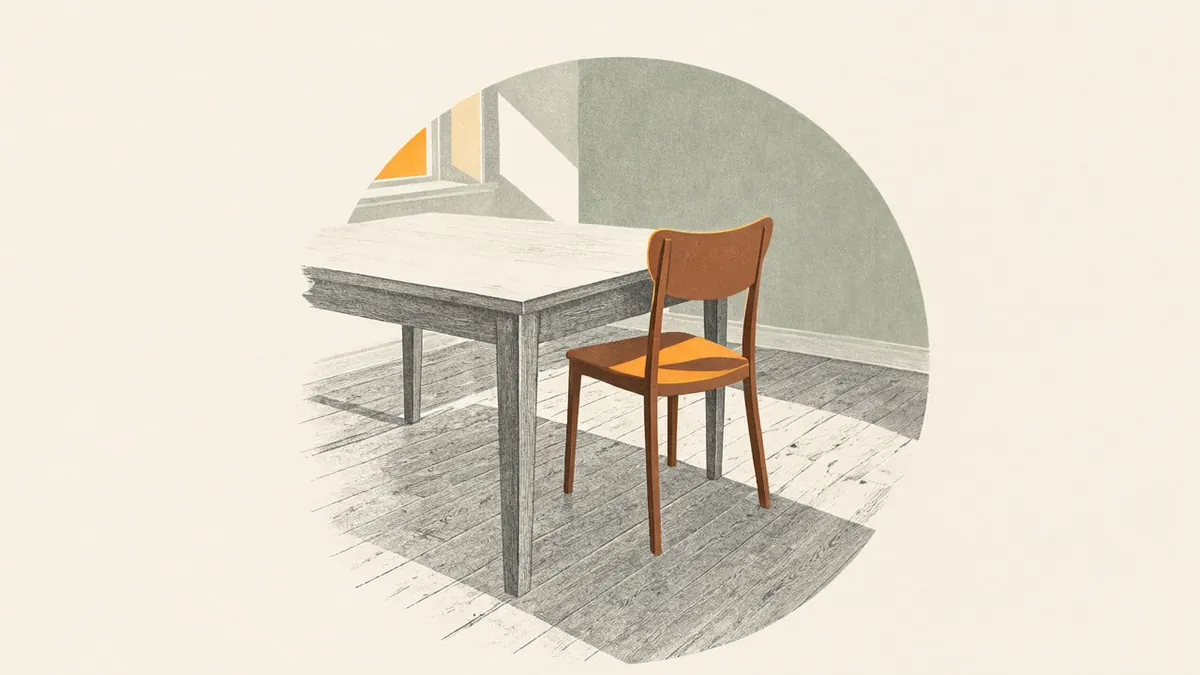
The most reliable single technique: show what is missing instead of describing what is felt. Grief lives in negative space, in the habits the dead person used to fill.
Here is a before-and-after from an example scene I wrote for this post.
Before (wallowing):
Devastated didn't even begin to cover it. Nora walked through the house like a ghost, her heart shattered into a million pieces. Everywhere she looked, memories of her father surrounded her, drowning her in sorrow.
After (absence):
Nora made coffee for one. Then she stood there holding the second mug anyway, because she'd picked it up out of habit, and the cabinet door swung shut on its own spring hinge.
Notice what the after-version refuses to do. It never uses the words grief, sad, loss, or heartbroken. It never tells you Nora feels anything. The second mug carries the entire weight, because a object-shaped hole implies a person-shaped hole without stating either.
To make this work, plant the objects early. Two or three chapters before the death, give the loved one specific possessions and rituals: the mug, the way he whistled when he shaved, the pile of library books by his chair. Then the grief scenes don't need to introduce new symbols. They just pay off what the reader already recognizes.
Let Dialogue Dodge the Subject
People who are actually grieving rarely say "I miss him so much." They discuss logistics. Casseroles. Insurance paperwork. Whether someone remembered to cancel the dental appointment. The avoidance itself becomes the characterization, because you can see them keeping a lid on it.
Give your scene mostly logistics, then allow one brief crack, well short of a breakdown. A useful rhythm looks like this:
"We should cancel his appointments," Martin said. He wrote it down in careful letters. "There were, I think, three."
His sister said nothing. After a while she asked, "Which days was choir?"
Nobody cries. Martin has stopped asking whether anyone wants the piano, which is the loudest sentence in the exchange, and it is entirely about sheet music. That is the register you want: subtext carrying the emotion.
One caution. Dodging works best when it has a limit. If every conversation deflects for eight straight chapters, readers conclude the character is cold rather than controlled. Plan one moment where the deflection fails, and make it small. Half a sentence of faltering is worth more than a page of tears.
Mix In Anger, Guilt, and Small Cruelties
Sadness alone gets monotonous by the second scene, and it also misrepresents how grief behaves. Real mourning braids in uglier strands: rage at the person for dying, irritation at casseroles and sympathizers, guilt over feeling relieved after a long illness, flashes of selfishness about practical things like money and living space.
These unflattering notes do double duty. They break the monotony of sorrow, and they build character, because how a person mishandles loss tells you who they are faster than how they nobly endure it. If the grieving character needs sharpening overall, it may help to revisit basic character development before touching these scenes again, since distorted behavior under pressure only lands if the reader knows the baseline.
A quick test: wherever your draft contains a sad action, ask what annoyed, resentful, or self-serving thought could sit next to it. If the answer makes the character slightly worse, keep it.
Pace Grief Across a Whole Book
Scene-level understatement is only half the job. Book-level wallowing looks different: four consecutive chapters of mourning with no forward motion. Readers handle any single heavy scene, but a run of them exhausts even sympathetic people.
Two fixes:
- Compress time with routine. Instead of dramatizing every day of the aftermath, write one half-page that summarizes weeks through repeated details. The meals she ate standing up. The phone calls she let ring out. Then resume live scenes at a point of change.
- Alternate registers. Between grief-heavy scenes, run plot, warmth, or even mild comedy. Humor belongs in mourning; wakes famously run on jokes. Letting a secondary character be funny beside your bereaved protagonist is not disrespect, it is relief, and relief makes the next dark moment hit harder.
Also remember that grief passes in waves on a delay. Sixty pages after the death, a song or a smell can level the character at an inconvenient moment, which doubles as excellent mid-book escalation.
Keep the Small Details Straight Through Revision
Grief pays off dependences hard. The mug on page forty becomes the mug on page two hundred becomes the mug the character finally throws away on page three hundred, and every link in that chain must stay accurate. This is exactly the consistency problem that makes writers keep a story bible in the first place: one running record of possessions, habits, nicknames, and unresolved threads tied to each character.
If you draft in WriteWithPaige, its story bible holds those same details across chapters automatically, so a fourth-chapter mug survives an eleventh-chapter rewrite. For the sadder parts of polishing the emotional register itself, a pass guided by self-editing principles usually catches leftover wallowing words like shattered, devastated, and unbearable.
The honest checklist, since emotion proves hardest to judge in your own draft:
| Wallowing marker | Quiet replacement |
|---|---|
| Naming the emotion (sad, devastated, broken) | An action that implies it |
| Weather mirroring mood (rain, gray skies) | Ordinary weather the character ignores |
| Crying described at length | One physical slip: a missed step, a swallowed reply |
| Characters speaking the theme aloud | Logistics, interruptions, changed subjects |
| Dead person idealized in flashback | A memory including something irritating |
Run a search for the naming words and the weather during your second revision pass. Wherever both appear together in the same paragraph, you have found wallowing under production conditions.
Frequently asked questions
Can you write convincing grief if you've never lost someone close?
Yes, because the techniques are observational, not autobiographical. Watch how grieving acquaintances behave in public: the logistics, the sudden bright smiles, the topic changes. Since all fiction requires inventing experiences you have not had, treat grief like any other research gap, and lean on the physical mechanics above.
Should grief scenes be written in first person or third person?
Both work, but third person limited makes understatement easier, because the narration can hold back information the viewpoint character refuses to face. First person risks the narrator analyzing their own feelings, which drifts toward telling. If you stay in first person, let the narration focus outward on objects and other people.
How far apart should the death happen and the big emotional breakdown?
Far enough that the reader stops expecting it. A controlled, quiet initial response followed by a delayed collapse ten or twenty thousand words later hits harder than immediate catharsis, because the delayed version surprises the character as much as the reader. Place the breakdown where it complicates something the character needed to do.
Do flashbacks to the dead person weaken present-day grief scenes?
Only if they arrive in bulk. One or two vivid flashback moments, especially ones showing friction or ordinary annoyance rather than tenderness, deepen the loss enormously. Lengthy elegiac montages in the past tense stall momentum, so cut any flashback whose present-day counterpart detail does not pay off later.
Want Paige to try these techniques on your story?
Start writing freeRelated reading
How to Self-Edit a Novel: A Pass-by-Pass Guide
You finished the draft. Now what? A practical, pass-based approach to self-editing a novel — structure first, then scenes, then line, then proof — and how to get real distance from your own prose.
How to Write Fiction in a Second Language: Four Workflows
A practical workflow for ESL fiction writers: plan in your strongest language, draft ugly, then layer your revisions so fluency lands where it counts.
Serial Burnout: How to Finish a 200k-Word Book You Hate
Your 200k-word serial stopped being fun somewhere around chapter forty and now every session hurts. Here's a procedure for reaching the end anyway.
Rename isn't revision: what your fic owes you for the novel version
Turning a fic into an original novel takes more than new names and a scrubbed canon reference. Here's how to replace everything fandom was doing for you, quietly, for years.